
In-Play Betting Guide
Live Betting Explained: In-Play Odds, Cash-Out & Latency
A complete Luxembourg guide to live (in-play) betting: how odds move in real time, how cash-out works, why latency matters, and how to stay disciplined.
Top betting sites for Luxembourg
Contains affiliate links · Operators’ terms and wagering requirements apply · More under Transparency & Funding.
What live betting actually is
Live betting — also called in-play betting — means placing wagers on an event after it has already started, rather than only before kick-off. Instead of a fixed pre-match price, you get a stream of constantly shifting odds that react to what is happening on the pitch, court or track in real time.
From a single price to a moving market
In a pre-match market, the odds are set, published and left largely alone until the event begins. In-play, everything is dynamic. A goal, a red card, a break of serve or a momentum swing forces the operator’s pricing model to recalculate instantly. That is what makes live betting both exciting and dangerous: the same match can offer dozens of different prices on the same outcome across 90 minutes.
For Luxembourg bettors, this matters because in-play is where most modern sportsbooks make the bulk of their turnover — and where the discipline gap between casual punters and sharp bettors is widest.
Why it suits some sports more than others
Fast, high-event sports produce the richest in-play markets. Tennis is a natural fit because the score changes point by point. Basketball and ice hockey offer near-continuous scoring and constant handicap and over/under repricing. Football remains the most-traded sport in-play worldwide, while esports, MMA & UFC, handball, golf and American football all now carry deep live offerings.
How in-play odds move
In-play odds are driven by a probability model that ingests live data — score, time remaining, possession, shots, cards, and much more — and converts it into a fair price, then adds the bookmaker’s margin on top.
The core drivers of a price change
Three forces move a live price:
- Match events. A goal, break point, foul or turnover changes the underlying probability of each outcome immediately.
- Time decay. As the clock runs down, the probability of the current situation persisting rises. A 1-0 lead is worth far more in the 85th minute than in the 15th.
- Money flow. Heavy betting on one side pushes a book to shorten that price and lengthen the other to balance its liability.
The mechanics behind the numbers
Consider a football match at 0-0. The “over 2.5 goals” price drifts steadily longer with every minute that passes without a goal, because there is less time for those goals to arrive — a direct example of the over/under market reacting to time decay. The moment a goal goes in, the same market snaps shorter again. Understanding why a number moves — event, time, or money — is the difference between reacting emotionally and reacting logically.
Suspensions and price freezes
When something significant happens, or is about to, the book suspends the market — it greys out and stops accepting bets for a few seconds. This protects the operator from being picked off during moments of uncertainty (a corner, a penalty review, a near-goal). Frequent suspensions are a normal part of live betting, not a glitch.
The latency problem — and why it decides who wins
This is the single most important concept for any in-play bettor to internalise, and it is where most casual punters quietly lose their edge.
You are watching the past
Most casual punters watch a “live” stream that is actually 30 to 45 seconds behind the action, while professional syndicates and automated bots operate on ultra-fast data feeds that update far closer to real time. In practice, that means by the time you see a dangerous attack on your screen and reach for your phone, the market has often already moved — or been suspended — based on information the operator received seconds ago.
What latency means at the betting slip
If you are betting on what you see on a delayed stream, you are effectively betting on the past. The price you click may no longer be available, or worse, the outcome you are backing may already have changed. This is why so many in-play bets are rejected with a “price has changed, accept new odds?” message: the market has already caught up to reality while your stream lags behind.
| Actor | Information source | Typical delay | Practical edge |
|---|---|---|---|
| Casual punter | TV / online video stream | 30–45 seconds | Reacting to old information |
| Data-service bettor | Fast statistical feed | A few seconds | Closer to real time |
| Automated syndicate | Direct low-latency feed + bots | Near-instant | Systematic advantage |
How to play against the delay
You cannot beat the bots on speed, so do not try. Instead:
- Bet on judgement, not on reflexes — form a view on the game and act before the decisive moment, not during it.
- Be sceptical of “surebet” opportunities that look too good; they usually reflect your delayed stream, not a genuine mistake.
- Accept that a rejected or re-quoted price is the system protecting itself, and never chase it.
Cash-out: your live exit button
Cash-out lets you settle a bet before the event finishes, taking a partial profit or cutting a loss based on the current in-play odds. It is one of the defining features of modern live betting.
How the cash-out value is calculated
The offered amount is derived from your original stake and odds versus the current live price of your selection. If your bet is going well, the cash-out figure sits above your stake; if it is going badly, below. Crucially, the operator builds a margin into that figure — cash-out is rarely a mathematically “fair” price, and over time taking it costs you a slice of expected value.
When cash-out helps and when it hurts
Cash-out is genuinely useful for locking in a good result on a long-running accumulator, where one remaining leg could wipe out the lot, or for managing a position when circumstances have changed (an injury, a red card) and your original read no longer holds.
It hurts when it becomes a nervous habit — repeatedly bailing out of winning bets early “just in case” surrenders long-term value to the bookmaker. Used with discipline it is a risk-management tool; used emotionally it is a slow leak in your bankroll.
Partial cash-out and auto cash-out
Many books offer partial cash-out (settle a portion, let the rest ride) and auto cash-out (automatically trigger at a value you pre-set). Auto cash-out is helpful precisely because it removes the in-the-moment emotion — you decide your exit calmly, in advance, rather than in a panic at 2-1.
A disciplined approach to in-play betting
Live betting punishes impulse more harshly than any other format, because the next opportunity is always seconds away. Structure protects you.
Set the rules before you start
Decide your session budget, your per-bet stake and your stop-loss before the match begins, and treat them as fixed. Sound bankroll management matters even more in-play, because the sheer number of available bets makes overstaking effortless. A flat-staking approach — the same fraction of your bankroll per bet — keeps a bad run from spiralling.
Bet fewer, better markets
The instinct in-play is to bet everything: next corner, next card, next point. Resist it. Concentrate on markets where you actually have a read — perhaps both teams to score when a game is opening up, a handicap when one side is clearly dominant, or a live total when you sense the tempo. Chasing every micro-market is how the margin grinds you down.
Hunt value, not action
The goal is not to have a bet on — it is to find a price that is wrong. That is the essence of value betting: backing a selection when you believe its true probability is higher than the odds imply. In-play, value appears when a market over-reacts to a single event (a soft red card, an early goal) before the model fully rebalances. If you cannot articulate why a price is wrong, you do not have a bet.
A quick discipline checklist
| Do | Don’t |
|---|---|
| Set budget and stop-loss first | Top up after a loss |
| Bet only markets you understand | Bet every micro-market |
| Use auto cash-out to remove emotion | Cash out in a panic every game |
| Accept re-quotes and move on | Chase a changed price |
| Track your results honestly | Rely on a delayed stream for “surebets” |
Live betting and the 2026 World Cup
The 2026 FIFA World Cup — hosted jointly by the USA, Canada and Mexico and expanded to 48 teams — will be one of the biggest live-betting events ever. The larger group stage means more matches, more in-play markets and, inevitably, more temptation. Every principle above applies with extra force during a tournament: the volume of games makes it easy to bet more than you planned and to fall for stream-delayed “value” that has already vanished.
Licensing: where do these operators sit?
Online gambling in Luxembourg is a state monopoly run by the Loterie Nationale, so the realistic route for most readers is internationally licensed operators that accept Luxembourg players. Understanding the licence behind a book tells you how much player protection you can expect.
The four frameworks you will encounter
| Regulator | Strictness | Player protection |
|---|---|---|
| Malta Gaming Authority (MGA) | High | Strong rules, complaint channels, segregated funds, audited |
| Curaçao | Moderate | Reformed and more structured than before, but lighter than MGA |
| Anjouan | Low | Permissive, minimal oversight |
| Kahnawake | Low–moderate | Established but relatively light-touch |
What this means for a live bettor
For in-play betting specifically, licensing affects how disputes over re-quotes, suspensions and cash-out settlements are handled. An MGA-licensed book gives you the clearest recourse if something goes wrong mid-match; the more permissive Anjouan and Kahnawake frameworks offer fewer guarantees. Always check the licence footer before depositing, and prefer stronger regulators when you can. Remember, too, that any welcome offers shown to you in EUR will differentiate a sports welcome bonus from a casino offer — read the terms, and never let a bonus dictate how you stake in-play.
Responsible gambling comes first
Live betting’s speed and constant availability make it one of the easiest formats to lose control of. Betting must always be entertainment you can afford, never a way to make money or recover losses. All betting is strictly 18+. Set deposit and time limits, take breaks, and never chase. If gambling stops being fun, seek free, confidential support and self-exclusion tools at begambleaware.org. If you feel your live betting is becoming compulsive, pausing in-play markets entirely is a perfectly sensible choice.
Our top picks reviewed

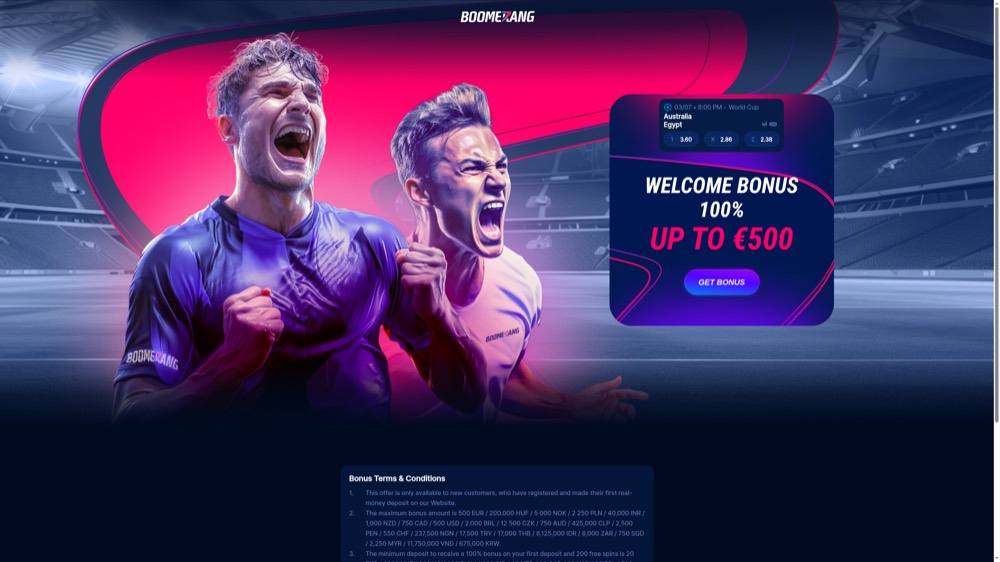
Boomerang Bet is a slick, feature-rich operator that impresses with a broad sportsbook and a strong casino crossover. Its generous welcome package and smooth mobile experience make it a standout pick for Luxembourg players comfortable with an internationally licensed brand.
Pros
- ✓Generous welcome bonus for new players
- ✓Wide sports and casino selection under one roof
- ✓Fast, intuitive mobile and desktop interface
Cons
- ✕Holds an international licence, not a Luxembourg (Loterie Nationale) licence
- ✕Bonus terms and wagering conditions should be read carefully before opting in
Bonus
100% up to €500

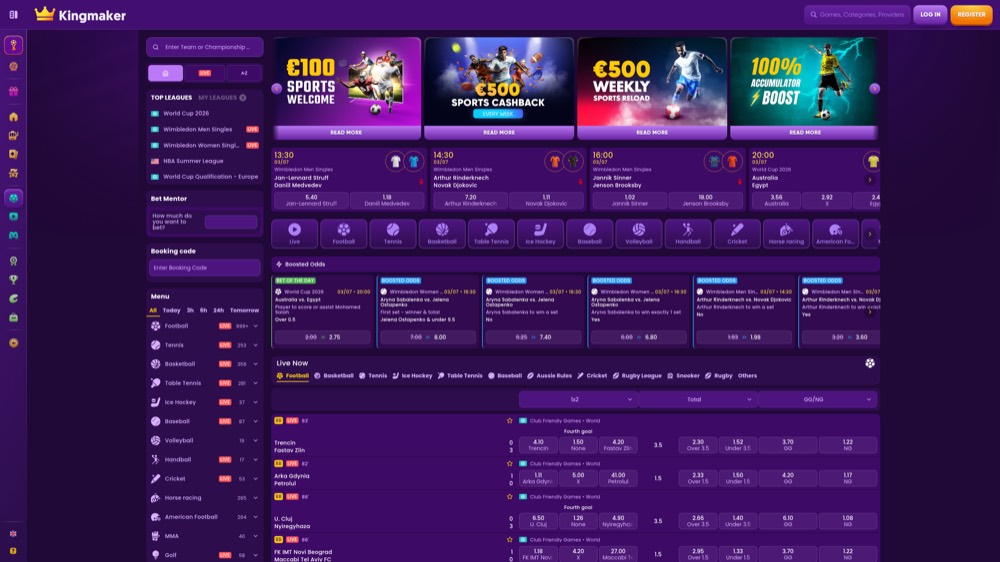
Kingmaker earns one of our highest editorial scores thanks to its slick sportsbook, deep market coverage and a welcome offer that gives new bettors plenty to work with. As an internationally licensed operator, it's built for players who want variety and competitive value.
Pros
- ✓Excellent all-round sportsbook experience
- ✓Generous sports welcome bonus for new customers
- ✓Broad range of markets and betting options
Cons
- ✕Holds an international licence, not regulated by Luxembourg's Loterie Nationale
- ✕Bonus terms and conditions apply
Bonus
€100 Sports Welcome Bonus


OnlySpins earns one of our highest editorial scores thanks to a slick, slots-focused platform and a straightforward welcome offer for new players. It's a strong all-round pick for Luxembourg players comfortable with an internationally licensed operator. Just be aware it isn't regulated by Luxembourg's Loterie Nationale.
Pros
- ✓Generous 100% welcome bonus up to €100
- ✓Slick, slots-focused platform
- ✓Smooth EUR payments
Cons
- ✕Holds an international licence, not a Luxembourg one
- ✕Bonus comes with wagering terms to check
Bonus
100% up to €100
FAQ
What is the difference between live betting and pre-match betting?+
Pre-match betting uses fixed odds set before an event starts, while live (in-play) betting lets you wager after kick-off on constantly changing odds that react to events, time decay and money flow in real time.
Why does my bet get rejected or re-quoted during live betting?+
Because the market moved before your bet was confirmed. Most video streams run 30 to 45 seconds behind the real action, so the operator has often already repriced or suspended the market by the time you click. Accepting the new price is optional — never feel obliged to chase it.
Is cash-out worth using?+
It can be, as a risk-management tool — for example locking in profit on an accumulator or exiting after a red card changes the game. But operators build a margin into every cash-out offer, so taking it habitually costs long-term value. Use it deliberately, ideally with an auto cash-out set in advance.
Can I beat the bots and syndicates in live betting?+
Not on speed — they use near-instant data feeds while you watch a delayed stream. Your edge comes from judgement: forming a view on the game and acting before decisive moments, focusing on markets you understand, and hunting genuine value rather than reacting to what you see on screen.
Which licence should a Luxembourg bettor prefer for in-play betting?+
Where possible, favour operators licensed by the Malta Gaming Authority (MGA), which offers the strongest player protection and dispute resolution. Curaçao is moderate, while Anjouan and Kahnawake are more permissive with lighter oversight. Always check the licence footer before depositing.
How do I stay disciplined with so many live markets available?+
Set your budget, stake size and stop-loss before the match and treat them as fixed. Bet fewer, better markets you actually understand, avoid chasing every corner or point, and use auto cash-out to remove emotion. If it stops being fun, stop — support is available at begambleaware.org.
18+ · Affiliate link · Play responsibly